Tuesday, January 27, 2009

Playing Below Capacity: Phoenix Coyotes


Welcome to the fourth edition of my little series here at Puck Money called Playing Below Capacity. Playing Below Capacity is where I take a look at teams that are playing in front of crowds of less than 85% at home (as of December) to see what they are doing right and wrong to try to get people in the seats. The first edition was the Devils, followed by the Kings, and most recently topped by the Predators (featured on Yahoo's Puck Daddy!). Today, its off to the desert of Glendale, Arizona; where the Coyotes are obviously in a boatload of financial concerns as of late. I will do my best to steer clear of those and focus on the attendance issues at hand. Phoenix is 25th in attendance ranked by capacity, with a rating of 84.6% through 24 home games. Let's begin.*

*Warning: Please remember that I'm a young college kid who thinks he knows what he's talking about. Any "problems" that I suggest the Coyotes have are my opinion and are most likely not that accurate. Also, any information I used can easily be found on the Internet as I am a typical lazy college kid. With that said, enjoy.

Here are the ideas I came up with that could be problems with getting people to go to Coyotes game on a regular basis...
  • Arena Location/Age
  • High Ticket Prices/Poor Promotional Events
  • Metro Population
  • On Ice Product
  • Location/History of Franchise
  • Other
Before we get going, some facts of the Phoenix Coyotes (wikipedia):
  • The "Coytoes" moved to Phoenix in 1996 after being known as the Winnipeg Jets since 1972. The Jets were apart of the WHA from '72-'79 and then merged into the NHL.
  • The Coyotes have made the playoffs five times in their 11 seasons in the desert. All five playoff appearances came in their first six seasons, their last in 2001-2002.
  • They originally played a the US Airways Center in Phoenix for seven years until 2003. The team then moved to Glendale to the new Jobing.com Arena.
  • The Capacity for Ice Hockey at Jobing.com Arena is 17,799.
And so we move on...

- Arena Location/Age

With Jobing.com being only six years old this season, I'm sure the quality of the arena isn't keeping fans away in the desert. What has been debated though is the location of the Arena, in neighboring Glendale, about 20-30 minutes away from Phoenix. Here is a screenshot via Google Maps (click to enlarge):


Jobing.com Arena is noted by the arrow labeled "B" in the picture. I asked Google for directions from Phoenix to the Arena and the blue line is what popped up, a 23 minute ride by car.

The Arena is on the outskirts of town, but Phoenix is surrounded by residential areas full of possible 'Yotes fans. Take another look at the picture. Downtown Phoenix isn't anything to imposing. Phoenix is basically set up like a giant retirement community. The roads are straight and the blocks are perfectly square, and like I said, residential areas all around. One thing I think that could make a difference is not playing in downtown Phoenix at the US Airways Arena, where the Suns of the NBA play and have always had better attendance.

To an outsider, it may seem like an issue. Some Coyotes fans in the link I provided above about the Coyotes home being debated about seem to think its really a non-issue. Take a look at this picture now (click to enlarge):


Many fans point out that the Jobing.com Arena sits right next door to the University of Phoenix Stadium; where the Cardinals have sold out every game and many college basketball games do well. This is a fair argument, but I still think that if the Coyotes were playing in downtown Phoenix, they might get a slight attendance boost.

I also wanted to mention the parking aspect at Jobing.com Arena. According to thesportsroadtrip.com, parking at the Arena is free, the only team in the major four to do so. There have been rumors that the Coyotes might start charging for the space, but none that I can link to.

- High Ticket Prices/Poor Promotional Events

The Coyotes made famous the "All you can eat" tickets, in an effort to draw a nice crowd on New Years Eve, 2008. It worked, somewhat. They saw their second highest crowd since opening night, with 16,199 packing into Jobing.com Arena to watch some hockey and eat their hearts out. As for ticket prices, the Coyotes don't (and really can't afford to) kill you. In 2008-2009, the Coyotes rank 28th in the Fan Cost Index at Teammarketing.com. The Fan Costs Index:
comprises the prices of four (4) average-price tickets, two (2) small draft beers, four (4) small soft drinks, four (4) regular-size hot dogs, parking for one (1) car, two (2) game programs and two (2) least-expensive, adult-size adjustable caps.
This years FCI for Phoenix is only one of four teams to decrease from last season. Their FCI is at $221.80, which is about $65 below the NHL Average. Their average ticket comes in at $37.45, about $12 below the NHL Average. Finally, which was a shock to me, their average premium ticket price is $129.23, about $15 above the NHL Average. Along with the low ticket prices, the Coyotes do some nice giveaways (mostly in the first half of the season), plus some great discounted prices (Only $20 for a lower-level ticket for students and military, wow).

Do I really think the ticket prices and offers are keeping fans away? No. The fact of the matter is, anyone that really wants to go to a sports event, especially hockey fans, will find the money to do so. But hey, at least the Coyotes haven't been accused of buying their own tickets like the Predators, yet.

- Metro Population

The cities of Glendale and Phoenix combine to have a population around 1.7 million people, with almost 50% of the population in Phoenix being non-Hispanic white, the NHLs main demographic. Glendale is ranked 28th by Statshockey.net in city population size in the NHL, but the Phoenix Metro Area comes in with just over 4 million people.

4 Million ranks Phoenix about average in the NHL in terms of Metro population. And as I showed you with the demographics clip, there is plenty of possible hockey fans. So the people are there, that's fore sure.

- On Ice Product

Everyone loves a winner. Take a look at this chart and graph below (click to enlarge):


As you can see, the real Attendance boost came in '03-'04, when the team had post two consecutive solid seasons and got their reputations up. Now that the Coyotes have an achieving young core poised to make the playoffs for the first time since 2002, the 'Yotes may really help their bottom line come this spring.

I think the On-Ice product is an issue. It is not THE issue for the Coyotes, but it definitely doesn't hurt to have a winner in what I like to call a "Bettman" market. I'll touch on that more later. If the Coyotes stick around in Phoenix, the crowds will be dazzled by Turris, Mueller, and Tikhonov for years to come. Throw in some solid goaltending by Ilya Bryzgalov and some pest-work by Daniel Carcillo and you being to see why the Coyotes are currently sitting in 5th place.

The Coyotes need to finish this season off strong on the ice to take some pressure surrounding the team and its ownership off the ice.

- Location/History of Franchise

It's the (favorite fun word here) desert. The Coyotes are in Phoenix because back in the late 90's player salaries got out of control and the small but constantly sold-out MTS Centre in Winnipeg couldn't support the Jets. Now, the fifth largest city in the United States, with a perfectly good arena and hockey club (this season at least), cannot support the Coyotes. Hockey is really only prevalent in Arizona because of the Coyotes and because of any retired folk there. I'm sure the Coyotes have grown the game a bit, but from my experience with USA Hockey (reading the monthly magazines, playing), you don't hear a lot about quality youth hockey being played in Arizona. What I will give the state is that they have the same amount of rinks of Tennessee and Georgia, combined (click to enlarge):


Off-note: 920 rinks in Ontario. Enough said.

- Other

I added this Other section because I have to share these photos when were talking about Attendance issues and the Coyotes. Plus I wanted to touch upon their meaning:


I took a look at who I think is "telling the truth" when it comes to reporting attendances back in December. The Coyotes fell into my "liars" list, naturally. Above is the Coyotes November 1st tilt against the Minnesota Wild. The reported attendance was 14,817. Now I have mentioned before on this site that it is really the clubs decision whether to announce the true attendance or the paid attendance. Some clubs, like the Coyotes, have to announce the paid; otherwise the team would be halfway to Ontario to play in one of its 920 rinks.

The above is truly a sad sight, but it is the results of a Bettman market. Phoenix is a great big US city with lots of televisions. This, contrary to Commissioner Bettmans hopes, doesn't necessarily equal a successful hockey market. Buffalo and Minnesota are successful hockey markets because the game is loved and put above all else there, and teams should always be in those markets because of this.

The Coyotes will obviously be receiving nice checks in the form of revenue sharing this season, no doubt about it. But when a team in the 5th largest city of the US is dead last in overall team value and has lost more money than one would care to know, along with being the only team in the league to actually lose value last season, why does Bettman insist on keeping this franchise in the desert? I know a lot of this is easier said than done, but how he can keep ignoring the fact that some of his Southern Expansion markets are just not going to work in the long run is beyond me (Atlanta and Florida are also to me not going to work).

- Conclusion

Attendance in Glendale and Phoenix has not been great since the turn of the century. But to be fair, neither really have the teams been either. To me, beyond the fact that the On-Ice product hasn't been great (with this season and '01-'02 being the exceptions) and the team moved 30 minutes outside of Phoenix, the bigger problem is clearly the market. And this isn't news, but more or less just a conformation. All the money news swirling around the club off the ice has surprisingly not affected the locker-room, which is promising. If the Coyotes continue down this path and cannot find a new owner, Mr. Bettman may have to concede to the very thing he seems to hate, relocation.

One last thing. Bettman seems to be content on selling the Coyotes to anyone who is willing to put up the cash (unless your name rhymes starts with a B and ends in alsillie). I'm sure fellow NHL Owners cannot pleased about this, as this may not be the best business strategy.

So that about wraps up the fourth edition of my series here at Puck Money, Playing Below Capacity. Be sure to check back next week as we should have another fun, relocation rant filled edition as the New York Islanders are next up on the list. Please feel free to comment and let me know if I made any mistakes.

More to come later, by the way.

Morning Roundup


I managed to find the Versus ratings for the All-Star game this morning...

USA Today reports the overnight coming in at 0.8 (616,000 households), a 12% increase from last season. Nothing to brag about, as the X-Games outdrew the game by .2, but it still hung around with a regular-season match.

moving on...

Ken Campbell of The Hockey News
says that the "free lunch is over" for NBC in regards to the NHL TV rights deal.

I'm late on this, but Campbell says FOX is apparently interested in bringing back the NHL. (Insert goofy fighting robot joke here). Campbell explains how I feel about a new TV-rights deal well here in this paragraph:
A new deal likely wouldn’t be a financial bonanza for the league, but it would provide some revenues and, more importantly, place some tangible value on the television product. Even though all facets of the business are bound to be hurt by the economic downturn, the NHL sees its television presence as an area of potential growth, particularly with the upcoming 2010 Olympics in Vancouver.
This was a setup that lead to more interesting news, though:
Speaking of outdoor games, look for next year’s to be played between the Montreal Canadiens and Boston Bruins at the 69,000-seat Gillette Stadium in Foxborough, Mass. The league has come to the conclusion that the outdoor games work much better in a football stadium than a baseball venue and a Montreal-Boston game would be great for ratings on both sides of the border.
I completely agree. There was nothing wrong at Wrigley, but to me playing in a football stadium year in and year out is just a no-brainer. More fans for a bigger gate receipt and the venue is already basically setup.

Check back later.

Monday, January 26, 2009

Clarification and another CBC-Bettman Interview

Just a clarification on my All-Star "Idea" from yesterday (see below).

I understand the All-Star Weekend format will most likely not be changed (especially anytime soon, with the show Montreal put on and the game itself last night). It is a cash-cow for the city that hosts it and it is very important for fanfare. The weekend alone brought in at least 10 Million for the NHL in sponsorship money, too.

Either way, it was a great game and a solid weekend. I'll be looking for the TV Rating it drew on Versus ASAP, as nothing was in today's Sports Business Daily.

Before the game last night CBC's Ron MacLean spoke with Gary Bettman for about nine minutes. Here it is:


Highlights from the Business standpoint:

- Economic "growth" of 5-6% for this year.
- Bettman confirmed high Escrow possibilities
- A top revenue-sharing team could be getting 17 Million Dollars this season. Wow.
- Bettman: "I believe that Relocation is only a matter of last resort..."
- Bettman stated that Balsillie "bailed out" on the two franchises he pursued.

A great interview. No real shocking news, but some clarifications from the head poncho.

A quick edit: I forgot to mention a quick Attendance stat.

There were 31 sellouts last week, the most since I started tracking sellouts in late December. The reason I say this?

Well there were only games from Sunday through Thursday because of the break. Quite a successful mini week. Total Sellouts for the season number at 361 now.

Something more later.

Sunday, January 25, 2009

Great Gary Speaks and My Opinion on the All-Star Weekend


Gary Bettman clarified some situations Saturday night about Phoenix, Nashville, Expansion in Southern Ontario, and the NHL in General.

On the Coyotes, Bettman said there are no plans to relocate them, or any team for that matter. He also said that "...there are some cash-flow issues." I'd say that's a safe statement.

Bettman said the following about the reports of Nashville buying their own tickets to qualify for revenue-sharing:
"They did not do it last year and they have not done it this year. We monitor very closely how clubs report [revenues],'' he said. "We are not going to encourage anyone to play games with the rules, in particular how it relates to revenue sharing."
As for Southern Ontario, he said that putting a team in such a market is "...not that simple." For once, I do agree with Mr. Bettman. Everyone looking from the outside in doesn't understand that relocating a franchise is so much easier said than done. Hell I don't even really know what it completely takes. Mr. Bettman did insinuate though that Hamilton would need a new arena if it became a possibility.

And Finally, Bettman predicts growth of around One percent. Some see this as a bad thing, but I don't really understand how, as a hockey and NHL fan, one cannot be grateful that the economic downturn hasn't struck down on the "smallest" of the big four.

Either way, some interesting comments over a slow All-Star break. Speaking of which...

I came up with this "idea" over the Summer 0f 2008 after the first Winter Classic. As a kid, I always liked watching the Skills Competition over the All-Star game. I watched the Skills last night and I will try to catch the game tonight. Either way, this weekend is important for fanfare and especially important for the kids, who are the future support of the league. So, here's my idea.

Scrap the actual game all-together. You move the new "Winter Classic Break" to start on Christmas day, going until New Years Day, when the league resumes play. You do the "Winter Classic Skills Competition" at the site of the Outdoor Classic either on the afternoon of New Years Eve or the night of December 30th.

Every major sport has a debate over whether to have an All-Star game or not every season, and with the success of the Winter Classic, you could use the outdoor game to highlight the league and what it stands for.

Maybe I'm just talking crazy, but I don't see how it couldn't work. I understand the All-Star weekend is also a lot about the money it brings in to the city that hosts, so once again it is easier said, than done.

Check back tomorrow and then Tuesday for another edition of Playing Below Capacity.

Saturday, January 24, 2009

Feeling Much Better

Sorry for my absence the past couple of days; I came down hard with a touch of the Flu. I feel a lot better as of this morning, so lets catch up.

- A thanks to Greg Wyshynski for featuring my look at the Nashville Predators attendance issues in his Tuesday morning Puck Headlines at Puck Daddy.

- Thusday the NHLPA Executive Board voted 30-0 to not re-open the current CBA between them and the league.

- Friday Sports Media Watch reported via Sports Business Daily that the Rangers and Penguins drew a 1.0/2 final rating; the highest for a regular-season game with NBC.

- Sportsnet.ca reported on Friday that the NHLPA will recommend to its members that escrow payments be almost doubled to 25% from the now 13%.

- Finally, here is a chart I made with basic information of NHL Arenas. There isn't one quite like it. I had an idea to go along with it, but to be honest I forgot it when I became sick. I'll use it for something, eventually. It is sorted by the year the arena opened (click to enlarge):


Thats all for now, Enjoy the All-Star weekend.

Wednesday, January 21, 2009

Tough Night, Not Feeling Well...

I had a tough night last night with some family issues and on top of that I woke up this morning not feeling too hot.

I am working on a couple of simple lists that I find interesting, and one thing that caught my eye this afternoon...

In today's Sports Business Daily, a title read:

NHLPA's Kelly Supports Exploring European Expansion For NHL


Kevin McGran of the Toronto Start quoted Kelly saying the following:
But he said the NHL has to "really test this market and determine whether or not it would be viable to put a couple of NHL franchises over there." Kelly: "You need to continue to look short term and long term. We have to look for growth opportunities in the coming years, which means bigger markets, better television deals. We have a natural market in most of Europe."
The IIHF's response?
The IIHF said that the NHL "would fail miserably, citing the fact that the NFL pulled the plug on its money-losing European league and saying the NHL would be seen as an interloper." IIHF President Rene Fasel: "It would be a potential disaster for this NHL's European division. I don't think anyone right now has the means to lose so much money"
Exactly how I feel.

Hopefully, something tomorrow.

Tuesday, January 20, 2009

Playing Below Capacity: Nashville Predators


Welcome to the third edition of Playing Below Capacity, a series here at Puck Money where I am looking at the teams that are playing (or were playing, when I decided to do this back in December) to see why certain teams aren't filling over 85% of their arenas. The first edition was the New Jersey Devils, followed by the Los Angeles Kings. Today, we make our way to Tennessee to visit the Nashville Predators. The Predators are 24th in Attendance ranked by Capacity, and they sit right at the magic number as of today of 85%. With that said, lets take a look at the Preds.*

*Warning: Please remember that I'm a young college kid who thinks he knows what he's talking about. Any "problems" that I suggest the Predators have are my opinion and are most likely not that accurate. Also, any information I used can easily be found on the Internet as I am a typical lazy college kid. With that said, enjoy.

Here are the ideas I came up with that could be problems with getting people to go to Preds game on a regular basis...
  • Arena Location/Age
  • High Ticket Prices/Poor Promotional Events
  • City Population
  • Financial Issues in Nashville, Tennessee (location of Arena)
  • On Ice Product
  • Location/History of Franchise
So before we dive in, lets take a look at some raw facts (yes, pun intended) of the Nashville Predators (All information taken from their wikipedia page, found here):
  • The Predators were founded in 1998 when Craig Leipold was awarded an expansion franchise in Nashville by the NHL
  • The Predators have made the playoffs four times in their 9 completed seasons. They have never gotten past the Conference Quarterfinals (first round). Their best finish in the league was third in 2006-2007.
  • They have played all 9 seasons in what is currently known as the Sommet Center; which was formerly known as the Gaylord Entertainment Center and Nashville Arena. The Sommet Center opening in 1996.
  • The capacity for Ice Hockey at the Sommet Center is said to be 17,113.
So, let the fun begin...

- Arena Location/Age

The Sommet Center is only 13 years old, and recently went through renovations in the summer of 2007. In these renovations, a new scoreboard was installed, along with changes to Concession and Public areas. The number of seats remained the same. Roughly looking at the ages of present arenas in the NHL, I would venture that the Sommet Center is around average age if not a bit older (I will look into getting a list together, I should know that stuff). As for location, the Sommet Center is in the heart of Nashville, as you can see here (Arena noted by the "A" arrow):


With a few major roadways leading to Nashville, and the Nashville International Airport to the South and East, I'd say the Sommet Center's location isn't a big issue.

- High Ticket Prices/Poor Promotional Events

As always, we will refer to Teammarketing.com, for our information. They rank the four major sports with ticket prices with their Fan Cost Index, which at a single game;
comprises the prices of four (4) average-price tickets, two (2) small draft beers, four (4) small soft drinks, four (4) regular-size hot dogs, parking for one (1) car, two (2) game programs and two (2) least-expensive, adult-size adjustable caps.
This season, the Predators are ranked 20th in the NHL with an FCI of $273.38, which is up 3.9% from last season but is till around 15 dollars below the NHL average. The average ticket price is $47.22, which is also up 2.8%, but still about $2 below the NHL average. The average premium ticket price is also about $5 below the NHL average at $107.91. Being below the average is good, and in the past couple of seasons, the Predators have done just that. But, ticket prices in Nashville have also been rising at a steady rate since at least 2005-2006; with the average ticket going up around $15 and the average premium ticket going up around $30. Is this outrageous? No, and considering inflation rates and the current economy, its not necessarily a big surprise either.

I couldn't find any Promotional Information on the Preds website at first, but after a google search I found the Predators Promotion page under the Fan Zone. I must say, I am impressed with their offerings. They tend to have something for every game, and they really mix it up. Offerings involving kids, the military, food, charity drives, pre-game parties, and college nights really hit home with a lot of different demographics. My favorite (real surprise here), would be the College night, where for $20 you get a shitty ticket and half-price on beer! Good stuff here, and I don't think its a major problem.

- City Population

Although Nashville has somewhat of a below-average metro population with a shade under 1.5 million, the city itself has almost 608,000; which ranks it right down the middle at 15th in the NHL. I think they could benefit a lot more from a larger metro population, but having the 15th largest city market definitely comes in hand at times. I wouldn't say the City Population is the big problem in Nashville for Attendance.

- Financial Issues of Nashville

As of 2000, the city of Nashville was 67% white, which (to be honest) are the overwhelming majority of Ice Hockey fans. The median age is 34, with 67% of the population under the age of 45, which is good for a 18-45 target demographic of NHL fans. The median income was just a shade under $50,000, which leads me to believe the average household income should be in the ballpark of the $88,000 average household income for NHL fans (Forbes). In general, I think people in and from around Nashville could afford a Predators game most of the time, but again I don't think this is the main issue (all above from wikipedia).

- On Ice Product

As I mentioned before, in 9 seasons the Preds have made the NHL postseason four times, all three ending as quickly as it began; in the first round. As an expansion franchise, this may be considered a small success, but from a business standpoint, it does not help the matter of the bottom line. 18 of the 25 players on the Nashville roster are under the age of 30, which is obviously good for the future. Three key players for the future are Defensemen Ryan Suter (23) and Shea Weber (24, Assistant Captain), along with Goaltender Dan Ellis (28), who had a stellar 2007-2008 season. As the saying goes, everyone loves a winner, and I think its no exception here. In an indifferent expansion hockey market, the best way to create and retain fans would be to win some hardware. Easier said than done, I know, but at the same time I wonder if this is really the case. Take a look at the graph below (click to enlarge):


Even when hype was the highest, coming off a solid post-lockout season in 2005-2006 with a 6th place finish, and an even stronger season in 2006-2007, the Predators couldn't even break the top 20. Now, I understand that the Sommet Center can only fit 17,113, and those ranks are by Average Attendance, not Capacity. But still, if a legitimate winning hockey team can't attract customers, what is the problem?

- Location/History of Franchise

The state of Tennessee doesn't exactly have the best history of Ice Hockey. According to Arenamaps.com, there are only 10 Ice Hockey Arenas in Tennessee. I'm sure the game is prevalent in small pockets, but as of right now I have no way of identifying that. The Predators have most likely grown the game, but I would venture a guess that it hasn't grown by much. Their Franchise History isn't exactly historic, as 2008-2009 is only the 10th season, and many rumours have already swirled around the club focusing on relocation. The Summer of 2007 provided much drama for the club, as Craig Leipold looked to sell the club. A deal was in place with Jim Balsillie, but fell through when Balsillie went too far with his relocation plans (pre-selling season tickets in Hamilton, Ontario). A group of local business owners who called themselves "Our Team Nashville" rallied to buy the team to keep it in town. Throughout this whole debacle, the team did manage to re-negotiate their lease with the city of Nashville. The changes are as follows (wikipedia):
If by the end of the 2009/10 season, the team loses at least $20 million or more in cash flow and does not average 14,000 per game in average attendance, the team can break it's lease with the city of Nashville by paying a $20 million breaking fee.
- Conclusion:

The Predators have a value of $164 million, which ranks them 23rd on Forbes' list this year. Their revenue is at $70 million, but with an operating income of $-1.3 million and a debt/value ration of 50%. Are the Predators in good shape? Not so much. Are the Preds in the worst shape in all the league? No. Frankly, I never thought Nashville was much of a hockey market. I see it more as an American sports market. One with a big enough population and TV market to support professional sports teams. Can they support the Predators? For now, but I don't know if it can last. The only other professional team in the big four are the Titans of the NFL; which means the Predators don't have to directly compete with an NBA or MLB team, which helps them. I can easily see the team moving in the next decade, to where I am not sure. The problem with the Predators is that you can't pinpoint one problem, which usually leads back to the hometown market. The On-Ice product isn't the greatest, but if no one will go even when they are winning, what does that say about the market.

If I was in Nashville, I would continue to keep the ticket prices as low as possible, along with doing as much promotional work as possible. Getting the On-Ice issues sorted out would be great as well, but that is always easier said than done.

So that's the third edition of my series called Playing Below Capacity here at my little blog. Check back next week around the same time, as I plan on looking at the Phoenix Coyotes, which should be a really fun one.

Maybe more later today...

Monday, January 19, 2009

Fun with Maps

Being bored, I took to the Internet doing some minor research on some possible relocation/expansion cities for the NHL. It first started as an NHL/NBA comparison along with other sports, but then it led me to some interesting sites with sweeeet maps.

The first site that got me thinking was the CommonCensus Sports Map Project. The first question is "Where do the fans for your sports team live?" I'm hooked.

Using their sister project, the CommonCensus Map Project, people are allowed to "record" themselves via their hometown. They then answer some questions based on how they feel they relate to the area they live in. Then, at the end of the questionnaire, you have the option to pick your favorite sports teams from the NHL, NBA, NFL, MLB, and Division 1 NCAA Football. You can pick your favorite, and then optionally pick your #2 or 3. I suggest you do it, and tell your friends, it kills time and it is slightly interesting.

The site says the maps are updated every couple of days, but the Maps itself says Updated as of June 30, 2008. Either way, its still cool. The NHL have the least number of "fans" (surprise surprise!) so far in this survey. Take a look:


As you can see, I clicked on the NHL map. And without further adieu (click to enlarge):


Plenty of Hockey fans (Vancouver) near Seattle, eh? Food for thought.

What does all of this mean? Nothing, at the moment. I will be using maps like these (and ones to come) over the summer when I look at teams and cities more in depth, so I'm glad I found them.

So, lets view some more maps...

First, a map with all the NHL teams (found here):

So exciting I almost fell over. I'm sure you felt the same. (ha).

And now we have a map of Pro, College, and Major Junior Hockey by County in the US (found here):


Gives a good idea of where hockey is watched the most, in my opinion.

And finally, a map I will definitely use again when it comes to analyzing teams and cities, we have this dandy which shows the number of Ice Hockey Rinks by State/Province throughout Canada and the US (found here):


The numbers that caught my eye were 87 in California, 51 in Dallas, and 39 in Missouri. Kansas City Islanders anyone?

So that's that. I realized as I was writing this I don't use many pictures, so I'll make more of an effort to do that. Check back tomorrow as I will have another edition of Playing Below Capacity.

Monday Afternoon Update

And I'm back. It was a long weekend and I apologize for no posts. Lets get moving though...

As I mentioned last Wednesday, E.J. Hradek reported that the NHL and NHLPA were working towards setting up another World Cup of Hockey, which I am all for.

Well Saturday Scott Burnside picked up more on that story, saying that the two sides have reached a handshake agreement on how the revenues will be divided up involving the World Cup, thus giving the 2011 event a green light. He also added that the NHL will be continuing to send teams to kick off the season over in Europe.

As you know I'm all for the WC of Hockey, I will now shed my opinion on sending teams to Europe. Burnside reports in that article that six teams will be sent to three European cities to kick off the 2009-2010 season, followed by eight teams to four cities the following season.

The Good? From a Business standpoint, it is great for the NHL and the individual clubs. The 2008 events in Prague and Stockholm this season were big hits and created an amazing atmosphere. Sellout crowds, international exposure, and increased media coverage are all benefits here.

The Bad? Well for the teams that travel, they lose one regular season home game, along with a preseason game or two. I would venture a guess that this upsets the hometown fans along with some sponsors, but at the same time it is very cool to be selected to represent the NHL abroad. From an on-ice standpoint, scheduling is a bit of a hassle. The 2007-2008 season kicked off with the Ducks and Kings in London at the O2 Arena, and later on in the season there was rumblings about how the Ducks were upset because they were fatigued and didn't get off to a good start in the season. I don't see that as much of an issue now, as the NHL staged the 2008 Premier earlier than the start of the regular season at home, allowing time for rest for the four teams that traveled (OTT, PIT, TB, and NYR).

Either way, I think both events are great for the league, and highlight the great sport that we all follow dearly.

More News...

Sports Business Journal once again provides a great piece on NHL Attendance and TV Ratings, which brings everyone up to speed for how the season is going. I missed this originally, but today's Puck Headlines over at Puck Daddy allowed me to catch this.

If you follow the blog, you know that in the past week I've looked at SBJ's updates on the Western Conference and the Eastern Conference about Attendance, so I won't go on repeating myself. But, SBJ did some great research into TV Ratings thus far, which are up nationally, and only down in seven markets locally. Here is the snapshot (click to enlarge):


The only real shocker to me in the change column (negatively) is Detroit. How do you win a Stanley Cup and then decline in TV Ratings? Weird.

One final thing, as I'm sort of pressed for time now...

Greg Wyshynski wrote the following in his Puck Headlines about the Sports Business Journal article describing the above:
But here's the problem: When Sports Business Journal writes that "five teams reported average attendance below 15,000 - the New York Islanders, Columbus Blue Jackets, Atlanta Thrashers, Nashville Predators and Phoenix Coyotes," we all know those numbers are remarkably generous because of the way the League counts "attendance" and because we're not blind. Stop crowing about records built on a foundation of discounts, giveaways and unused tickets.
Now don't get me wrong, I agree fully with him. I've already taken a look at who I think is lying about their attendance numbers and who is telling the truth, but lets step back for a second.

I firmly believe that the NHL is not the only league that differs their attendance from how many are present in the building and how many tickets were sold, but this isn't anything new. Therefore, I don't see this as a big deal. Why? Well, from the business point of view, if I had a job in the Marketing Department for the New York Islanders (well first I would hit myself being a Rangers fan), I wouldn't be worried about if the person that bought tickets attend the actual game, I'd be worried about getting the payment for those tickets. So, although it is slightly unethical for some teams to be doing such a thing, it is (to me) somewhat of an evil necessity for certain teams' market.

That is all I have for now, possibly more later, if not definitely tomorrow.

EDIT: a quick note...

Last Weeks Sellout Count: 25, which brings up the total this year to 330. Saturday night was a big night, with 9 out of 11 games selling out, most surprisingly the Islanders and Predators "selling" out.

Thursday, January 15, 2009

Some News and Future Plans...

First, the news of today...

TSN's Darren Dreger reports that the New York Islanders will be playing an Exhibition game next September at Kansas City's Sprint Center, a beautiful 18,500 seat arena in the heart of KC, against the Los Angeles Kings.

What does this mean? Well, a little bit of nothing. Dreger rightly speculates that this is supposed to be somewhat of a scare tactic by the NHL to Charles Wang, who refuses to threaten to move the franchise in order to accelerate his Lighthouse Plan. The plan is to ultimately renovate the Nassau Veterans Memorial Coliseum, and to develop the 100 acres around it with plenty of consumer attractions.

Other than that, the Islanders are no where near moving. I'm sure this game will be close if not a complete sellout as the Kansas City area doesn't get to see much hockey. But only time will tell on that.

As promised from yesterday, the Western Conference Attendance update from Sports Business Daily.

The notable gainers are the Blackhawks, who are up 49%, and the Blues, who despite being in last place (as I took a look at previously here), are up 8.1%. The Red Wings are also up by 6.6%, who are joined by none other than the Phoenix Coyotes, who are acutally up 4.7% this season from last. The only teams to really decline are the Avalanche (down only 4%) and the Kings (only down 2.4%.

The verdict? Great stuff. I would venture a bet to say that, in general, the Eastern Conference typically outdraws the Western Conference, seeing as Hockey is just generally more popular in the northeast (I think I'm going to look into this somehow). Why is this great stuff though? Well as I showed yesterday, 12 out of 15 teams in the East are either breaking even or declining in attendance thus far. As for the West, only 8 out of 15 teams are breaking even or declining this season. And as a whole, the Western Conference is up 3.5% this season, averaging 17,387 this season as opposed to under 17K last season at this point. So props to the West.

Finally, just some house-keeping on what I plan to do while at school here, where I don't have as much time to post than as if I'm on break when I started this.

I plan on doing something original (Playing Below Capacity series, or something else) probably once a week. I will try to report news like this as much as possible, but I understand I'm not breaking the news, so its not as interesting. I am spending my class time trying to think of interesting things to write about, I can promise you that.

So thats all I have for now, have a good day. I wouldn't expect much until Sunday.

Wednesday, January 14, 2009

NHL Attendance up 1.5%; Other News As Well

I don't have anything personal planned for today, but plenty of stuff coming out of Sports Business Daily...

- NHL Attendance is up 1.5% this season thus far, averaging 17,306 fans per game. Notable gainers are the Washington Capitals (up 29.8% from this time last year) and the Boston Bruins (up 12.3%). Notable declines include the Buffalo Sabres (down 12.4%, still not struggling though) and the Tampa Bay Lightning (down 11.6% thus far). The Thrashers (-7.9%) and Senators (-4.3%) are also down this year by a worthy amount as well. The Article says the Western Conference update will come tomorrow, so I'll be looking for that.

My thoughts? Good and Bad. The chart provided with the article shows that 12 out of the 15 Eastern Conference teams are either down or breaking even on Attendance from last season. Also, as a whole, the Eastern Conference is down 0.5% from last season. Are these numbers so staggering to really start to worry? Not at all, especially considering the current economic conditions. In fact, I would consider it along the lines of dodging a major bullet. Buffalo being down a little shouldn't be a major shocker to anyone, as it is a middle-class smaller market, where the effects of the economy are most likely hitting home. But still, plenty of Sabres fans are getting out to HSBC Arena with their 99.2% Capacity rate thus far. On the flip side, the Capitals are taking advantage of a tough Washington sports scene at the moment, and are on the radar of many casual sports fans in the area, and they have earned it. Boston has earned it as well, as they are in a city of champions in the past five years, and some Bruins fans are coming out of the closet hoping the B's can join in on the fun.

- From the Monday (1/12) issue of The Daily, Liz Mullen reported that NHL Player Reps will vote later this month on the current CBA, and are expected to extend it another two seasons.

Not much else there than that, it will be a hotter topic as it gets closer, but for now lets hope no problems arise between now and then.

Finally, kind of a non-business post, but nonetheless important to me, as I love international competitions...

- E.J. Hradek reports in his blog today that the NHL and NHLPA are working toward setting up another World Cup of Hockey, hopefully around late August through September of 2011, with Feburary 2012 as a backup date. That date doesn't look good, though, due to the fact that the NHL season would have to be halted once again. Hradek also said "The parties would like to stage a World Cup every four years, making it a regular event on the long-term hockey calendar."

My take? To take from Chris Farley; GOOD! GREAT! GRAND! WONDERFUL! NO YELLING ON THE BUS! With the 2010 Olympics having a good shot at being the last involving NHL Players for a while, I'm all for this. Because, I mean from what I know, the Olympics will obviously never be moved to another date, and unless the IIHF steps in and begins talking to the NHL about the problem, shutting down the NHL every 4th year will not be happening again. The last World Cup was held in 2004, and was considered a good success for reviving the tradition. So I say lets make it happen.

Tuesday, January 13, 2009

Selling out in Last Place; the St. Louis Blues

St. Louis may be the most under-rated hockey town with an NHL franchise. If you managed to find this blog in its early days (all of about a month ago), every night when I reported attendances I was always pleasantly surprised with the attendance figures coming out of St. Louis. I kept saying over and over, I have to take a look at what is making so many people get out to see a Blues team that is in last place in the Western Conference. I haven't found anything too revealing, but I have found that hockey is deeply rooted in St. Louis.

For your viewing pleasure, here is St. Louis' average attendance of recent years (click to enlarge):


Let's start with some raw facts about the team. The Blues are the 25th most valuable team in the NHL at $162 million, which is up 12% from last seasons value of $144 million. Their revenue jumped from $68 million in 06-07 to $73 million last season; $24 million of that being gate receipts. The problem with the Blues? Their debt over value is 74%, and their operating income was at $-8.6 million for last season (All above from Forbes).

OK, some good, and some bad. But along with the good attendance, good TV Ratings are occurring as well in St. Louis. As of December 3rd, 2008, the Blues Average Local rating was 1.9; tying them at 6th in the league with the Colorado Avalanche (Nielsen Blog).

Among all this is a big reason why the Blues have sold out 16 of their 21 home games thus far this season. The St. Louis Blues at the Scottrade Center are the cheapest team to go see. Their average ticket price is $29.94, almost $20 less than the NHL Average $49.66. Their Fan Cost Index, which is the average amount a group of four will spend at an NHL game for each particular franchise, is $193.26. They are the only NHL team under $200 in the FCI, and are about $25 cheaper to see than the 2nd cheapest team to see, the Carolina Hurricanes. The Blues FCI is almost $100 dollars below the NHL Average of $288.23, too (All above from Teammarketing.com).

The price of the tickets in St. Louis is one of two of the major reasons the Blues are drawing great crowds for a struggling team. If you take a look at the Blues website and check out their ticket deals, they aren't doing anything radically different from other teams. They have their basic flex and pick 'em plans, along with family deals and student nights. So it really isn't the ticket deals that are doing it, its just the prices that get them in the door.

Along with the prices though, there are plenty of Blues die-hard fans, which is the other major reason the Blues are filling up the Scottrade Center. As the TV ratings show, plenty are watching from home too. A quick google search of "St. Louis Hockey" and there are a bunch of results, many of which are youth hockey teams. One site that caught my eye though was the St. Louis Local Hockey Network, which started in 2004 and focuses on helping hockey players and fans unite and enjoy the game around the St. Louis area.

Finally, another aspect that helps the Blues, whether they want to admit it or not, is the fact that there is no NBA franchise in the area. St. Louis is ranked 21st in NHL City Population, with only 353,837 as of March 10th, 2008; but with a metro population of 2,801,033. If there was an NBA franchise in St. Louis, the attendance may not be affected much, but I think the TV ratings may drop due to game conflicts with TV rights.

That is all hypothetically, though. The fact of the matter is, the Blues management is filling the Scottrade center night in and night out with cheap tickets and die-hard fans. They better take care of their on-ice issues soon though, or some of the fair weathered fans may start staying away. If the team can gain some momentum at the end of this year and start of strong next year, a sellout streak will start soon in St. Louis.

Monday, January 12, 2009

Capping Off the Minor Comeback...

Checking my blogs right after posting, I found this amazing article at the New York Times' Hockey Blog, Slap Shot.

Stu Hackel has posted a fantastic piece centering on the Phoenix Coyotes mess. It is a nice compilation of all the reported news of the past 2 months, along with a look back at financial troubles of past teams in a similar position like the Coyotes. It also digs a little deeper into some of the decisions Coyotes' heads have made over the past decade or so.

How Did the Coyotes Mess Happen? - By Stu Hackel


My favorite part of the article:
“Historically, the Coyotes are a symptom, not the disease,” Brunt writes. “They exist in their current straits because of the N.H.L.’s rose-coloured aspirations to conquer America, aspirations that had been kicked around for decades but really took flight after Gretzky was sold to the Los Angeles Kings in 1988 and set off hockey mania in Southern California. The Phoenix franchise shifted from Winnipeg because the league had in theory outgrown that city and the market. The question of solid, grassroots hockey interest was beside the point; the sport packaged properly, the conceit was that the league could sell it to anyone.”
A great way to put it.

Finally, great news about the NHL Network today from Sports Business Journal.
NHL Network is about to announce a distribution deal with AT&T’s U-Verse system, a small agreement that will see the league-owned channel add about 250,000 homes to its distribution platform.

The deal, which pushes the network closer to the 12.2 million-home distribution mark, could be a good omen as the channel tries to double its distribution and complete a relaunch by next fall.

Oh, but there is so much more:
“Our plans call for us to be in 30 million homes by the start of next season,” said NHL COO John Collins.
How to do all this?
Now, league executives will try to increase distribution by convincing cable and satellite providers to move the channel from sports tiers to better distributed digital tiers. To entice the distributors, the network is offering an equity stake in the channel, Collins said.
Yee Haw! Now so I don't get myself into any more quoting trouble, I'll do a quick summary. The Network will be launching Eight (Yes, 8) new shows over the summer, which range from talk shows to replaying classics. It is also adding programs with new deals involving CBC, USA Hockey, and the Central Collegiate Hockey Association.

Sweeeeeet.

Along with this, a new studio that should be ready by mid-September for the Network re-launch. Looks like Puck The Media's message got to them.

I'm officially looking into ordering the NHL Network if this happens.

Have a good night, and I hope I can be around more.

Playing Below Capacity: Los Angeles Kings


And here is the second edition of Playing Below Capacity, where we will focus on the Los Angeles Kings, who rank 23rd in Attendance Percentage Capacity in the league. The Kings currently lead the NHL with 27 home games thus far as of today, which is three more than anyone else. They have only sold out seven of these games, but five of those sellouts have come in the past five games. The first edition was on the New Jersey Devils, who are just above them at 22, in case you missed it. This will follow the same format as the previous one. With all that said, lets take a look at the Kings.*

*Warning: Please remember that I'm a young college kid who really doesn't know what he's talking about. Any "problems" that I suggest the Kings have are my opinion and are most likely not that accurate. Also, any information I used can easily be found on the Internet as I am a typical lazy college kid. With that said, enjoy.

Here are the ideas I came up with that could be problems with getting people to go to Kings game on a regular basis...
  • Arena Location/Age
  • High Ticket Prices/Poor Promotional Events
  • City Population
  • Financial Issues in Los Angeles, CA (location of Arena)
  • On Ice Product
  • Location/History of Franchise
So before we really start, lets take a look at some basic facts of the LA Kings (all information taken from their wikipedia page, click here):
  • The Kings were founded in 1967 when Jack Kent Cooke was awarded an NHL Franchise the year earlier.
  • The Kings have only won their division once, in the 1990-1991 season. They have only gotten past the second round of the playoffs once as well, when they won the Western Conference Championship in 1992-1993, but then losing to Montreal in the Stanley Cup Final in five games.
  • The Kings began playing at The Forum in Inglewood, California, before moving to the new Staples Center, which opened for the 1999 NHL and NBA seasons.
  • The Staples Center for Ice Hockey is said to be 18,118 (Wikipedia)
Let the fun begin...

- Arena Location/Age

With the Staples Center turning only a decade old in October of this year, I doubt the Staples Center is much of an issue for attracting fans. The Staples center is actually the 5th youngest arena in the Western Conference, only older than Columbus, Phoenix, Dallas, and Minnesota (Colorados' Pepsi Center also opened in 1999). And being located in Downtown Los Angeles, I think the only problem with that would be traffic getting in and out of the city if one was to commute regularly to games from outside of the city. Still, it shouldn't be that bad.

- High Ticket Prices/Poor Promotional Events

According to teammarketing.com, the Kings average ticket price is up 2.7 % this season to $47.20, putting the Kings about $2.50 below the NHL average of $49.66 (all from here). Their average premium ticket price is $105.24, which hasn't changed in the last three years, and is about $8 below the NHL average of $113.44 (teammarketing.com). This is looking good thus far. The Kings have not raised their average premium ticket price the past couple of seasons, when they easily could have, and they are staying modest with the average ticket prices for the casual fan. I don't see anything quite wrong here.

Now lets remember, Teammarketing.com ranks its NHL list by what they call the Fan Cost Index, The FCI:
comprises the prices of four (4) average-price tickets, two (2) small draft beers, four (4) small soft drinks, four (4) regular-size hot dogs, parking for one (1) car, two (2) game programs and two (2) least-expensive, adult-size adjustable caps.
For the 2008-2009 season, the LA Kings rank 14th in FCI, which means the group of four drops about $281.31, which is roughly $70. Costly? Somewhat. The good thing about this is that going to a weekend game with an average ticket price from the Kings, assuming that you're not driving across country to see the game; the group of four could keep their costs under a $100 for the night. That is very doable. Now the Kings' FCI is up 3.3% from last season, but is still under the NHL Average FCI of $288.23, which in general is up 5.5% from last season.

So the tickets aren't all bad, how about some deals, though? If you venture to the Kings website and click on "Discounted Offers" under the "Tickets" tab, you find their four main deals:
  1. Hockey Night Out - "Enjoy a great night with friends, food, fun and hockey. Pack includes two (2) tickets, two (2) nachos and two (2) beers starting at only $53, a savings of over $26! Upgrade to the lower level for just $115.50."
  2. All You Can Eat - "The All U Can Eat Pack includes a ticket to the Kings game and all you can eat hot dogs, nachos, peanut, popcorn and soda starting at just $27 for all Monday games ($36 for all games)! All U Can Eat Seats are available for EVERY game!
    Click here to purchase ($36)...and take advantage of our All U Can Eat Value Mondays ($27) ."
  3. Family Pack - "Starting at only $21 a person, receive 1 ticket, 1 hot dog and 1 soda. Receive 1 free parking pass for every 4 tickets purchased!"
  4. College Nights (photo displays price of $10) - "Discounted tickets available online or at STAPLES Center Box Office with college ID on game nights and during regular business hours."
Good deals appealing to many different demographics. I wouldn't say LA is leading the pack here, but they are doing their part for sure.

- City Population

The Kings do not have an issue here. Los Angeles is populated with just under 4 million people and has a Metro Population a shade under 13 Million (Statshockey.net). What else can I say? L.A. is the second largest city with an NHL franchise in the league, with its nearest rival being Chicago, who still trials them by a million within the city and 3 million in the Metro.

- Financial Issues of Los Angeles

Once again, everyone is hurting due to the latest recession, but as of 2007 the Los Angeles combined statistical area has a gross metropolitan product of just under $700 billion, putting the area second to New York City in the Western Hemisphere (Wikipedia). This includes much of the suburbs and smaller cities around LA, but I'd bet a good amount that a solid portion of that figure is from either directly or within 20 miles of LA.

- On Ice Product

The Kings have not made the playoffs since the 2001-2002 season, and have made the playoffs 23 times in their 40 completed seasons. But, as I mentioned earlier, have only made it past the second round once, and only to the Stanley Cup Finals once as well, falling to the Canadiens (Wikipedia). On the upside, the Kings management has slowly began building a team for the future. Out of the 26 players on the Kings roster, only 7 of those players are aged 30 or older, with no players at the ages of 27 through 29 (Wikipedia). Personally, their biggest concern is goaltending, where two young goaltenders may need a couple of seasons to pan out. Either way, the Kings have a 24 year old Captain in Dustin Brown; and if they are able to keep their young core, the Kings should be able to break out of last place in the Pacific.

- Location/History of Franchise

Southern California isn't exactly a hockey haven, but there are very competitive youth hockey programs that do well in USA Hockey's National Championships year in and year out (from my experience reading USA Hockey Magazine). They are also very heavy into Roller Hockey, where it is seemingly easier to play due to Southern California's climate.

The Kings haven't had a very winning past, but you can't say they haven't been successful. They played host to the Great One (Wayne Gretzky) from 1988 to 1996, and had some of their best years during his stay. In general, a couple of consecutive runs deep into the playoffs would really grow the fan base, but they still draw well considering their place in the standings recently.

- Conclusion

The Kings are easily the safest team of all the teams playing below capacity. They are 12th on Forbes' NHL Team Valuations, coming in with at $210 million along with a revenue of $91 million and an operating income of $1.2 million. With all this good, they do have a substantial amount of debt over their value, which is 87 %. But, ever since the lockout, their revenue and overall value has risen every year (all from Forbes).

So what can the Kings do? Honestly, after looking at it all, I think most of it comes down to the on ice product. This season, they are averaging a shade under 16,000 a night (ESPN), but their last five home games have all been sellouts, with a total of seven on the season (My Excel Graph). Not bad for a last place team in the Pacific division. I think in two seasons the Kings will be a force to be reckoned with, and more and more seats will be filled night in and night out at the Staples Center.

So there is the second division of my little series here at my little blog. Once again, I will look it over and see what I can do next time. I hope you enjoyed the read. Please feel free to comment on any aspect of the article.

I'm Still Here, Believe It or Not...

I understand my posts have nosedived the past 2 weeks, and I apologize. I'm just trying to get into my new groove in a new semester at school. After this post I'm going to pump out a fresh version of Playing Under Capacity, focusing on the Los Angeles Kings.

One little tidbit that isn't old news:

Ever since putting up my Playing Below Capacity piece on the New Jersey Devils, more and more fans have been quietly sneaking into the Prudential Center.

At the time I wrote the article, they were already above the 85% threshold, with their reported figure at 85.7 %. Since then though the Devil's Percent Capacity has risen to 86.6 %! I'm taking all the credit for the upswing, by the way.

Check back soon.

Thursday, January 8, 2009

Coyotes News, Graph tidbits...

Wednesday was moving day for me, back up to college. Once I get my footing this weekend, there should be some more stuff.

On Wednesday, the Arizona Republic reported the Coyotes laid off 18 employees due to their economic condition, which is about 10 % of the staff. (Sports Business Daily)

According to Coyotes President and COO David Moss, they mad the cuts in "ticket sales, game operations, administration, public relations and community relations."

The end of the article:
Moss said that the team "would rely more on technology to make ticket sales, which he said are up by nearly 90,000 compared to a year ago." He also said that the "amount of free tickets the team gives away is down nearly" 75%. Moss: "Things are moving in a good direction, but we still lose a considerable amount of money"
Makes sense given Internet usage today. And it is also good to see that the number of free tickets being given away is way down, even though it doesn't look great on television.

Finally, after updating the Attendance spreadsheet today, I thought I'd let you in on these tidbits:

- Through Sunday the 4th, there have been a reported total of 279 sellouts. I will be keeping track week by week the change in the number.

- The Largest Crowd thus far was in Chicago on Friday, November 14th, when they hosted the Blues in a 4-3 OT loss. It was reported at 22,712. Wow.

- On the other hand, the Smallest Crowd thus far was 10,183; when the Islanders hosted the Dallas Stars on Thursday, October 23rd. The Isles lost 5-3.

That's all for now.

Tuesday, January 6, 2009

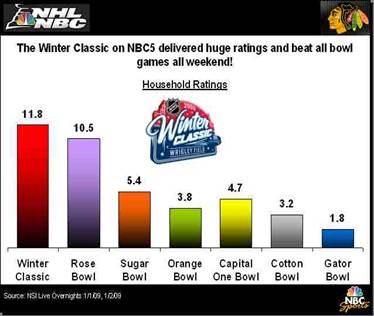
Winter Classic Beats All Bowls in Chicago...

Mirtle put this up around 1 PM, courtesy of the local NBC affiliate in Chicago...


Well that sure is interesting...

As one comment pointed out, this doesn't mean more people were watching hockey than football:
This was my first thought upon seeing that chart, and just in case anyone else was wondering, too:
Winter Classic—11.8
All the bowl games—29.4.
But hey, it still won the individual race, right? Well at least in Chicago it did.

Maybe more later...

Monday, January 5, 2009

Catching up on Old News...

First things first: the 2nd Winter Classic.

40,818 Blackhawk, Red Wing, and hockey fans packed the friendly confines at Wrigley New Years Day for the Noon start. It was a great spectacle indeed.

The game counted as a sellout home game (20,500) for the Hawks, their 18th of the season. I doubt that the figure included the packed rooftops around Wrigley, but I doubt it did. All in all, what else can I say about the event that already hasn't been said? It was a success in so many ways, and I look for it to come back annually for at least the next 3 years.

Puck the Media reported the top 10 markets for the television ratings of the classic. The game earned a 2.9 overnight, the highest regular-season rating in 13 years.
Top 10 Metered Markets:
1. Chicago 11.8/21
2. Detroit 10.5/20
3. Buffalo 10.1/20
4. St. Louis 5.3/10
5. Pittsburgh 4.4/8
6. Denver 4.2/10
7. Providence 3.5/7
8. Indianapolis 3.4/6
9. West Palm Beach 3.3/6
10. Orlando 3.2/5
St. Louis is really turning into a hockey town these days... With the Blues selling out 16 of their so far 21 home games, they are enjoying great success everywhere but on the ice; where the team is in last place in the west. They are a young team, and the fans dedication will pay off in the coming years. You also gotta love the last 4. No doubt all the transplanted hockey fans in Florida were tuned in, but Providence and Indianapolis?

Providence is home to the Providence Bruins, Boston's AHL counterpart. They enjoy relatively good success for the AHL, ranking 10th in Attendance and averaging 5,206 a night at the Dunkin' Donuts Center in Providence (11,000 Capacity). As for Indianapolis, I'm not sure what the big draw to outdoors hockey exactly was.

Other than that, a great review of the classic was done by Greg Wyshynski over at Puck Daddy.

Moving on...

Puck the Media had another great piece on Friday, lending some suggestions to the NHL Network on how to step it up (this a day after the MLB Network launched, which has been given great reviews, I guess). The suggestions?
1. New Studio. Now, if not Sooner.
2. A Little More Conversation on “On the Fly”

3. More Inside Info
That's all I have for now, check back tomorrow.

Where have I been, eh?

Ever since New Years Eve I've been very busy for some reason. I apologize but at the same time it gave me thought to as how much I can actually do with this blog.

The fact of the matter is, I'm only a college student. I realized yesterday that I will not be able to report the attendances daily like I have been during my Christmas break day in and day out. So where do I go from here?

Well I'm still gonna record each attendance in the spreadsheet like planned, but I won't be posting them daily. I'm basically switching my focus from day to day attendance reporting to some more advanced stuff when I get the time (such as the Playing below Capacity series). I plan on taking a look at the Winter Classic ratings later along with some other news.

You'll still here plenty about attendance, as that is what I'm most curious about. I just don't think I will be able to post as frequently as I have over the past month. But, with that said, I really don't wanna give up on this blog, as I see it as a tool I can successfully use to market myself when it comes time for me to get a job.

With all that said, I'm still here, but with a slightly different mindset. To anyone that checks this site often, just leave a comment. You don't even have to write anything, I just want to see if this is worth continuing.

Thanks, Rob